Big O
Priority: Must. Use the roadmap to decide when to study this topic.
An input size is a variable, not a runtime measurement. Bound time and auxiliary space separately, including recursion and copying; simplify only after deriving the count. Two independent sizes should remain separate variables unless their relationship is known.
Recognition signals
Section titled “Recognition signals”Signals: Repeated scans, growing recursion trees, copying slices, or a required scale.
First question: What exact operation repeats, and how many live objects coexist?
False friend: A nested loop is not automatically quadratic if one pointer never resets.
Retrieval and transfer check
Section titled “Retrieval and transfer check”Compare an n-by-n pair scan with two monotone pointers; justify total increments and peak space.
Be careful
Section titled “Be careful”Two consecutive loops add their costs; nested independent loops multiply them. A loop that halves its range is logarithmic.
Practice linked to this topic
Section titled “Practice linked to this topic”Intuition
Section titled “Intuition”Count how work changes as input grows. Choose a basic operation, count its executions, then simplify the growth rate.
Variations
Section titled “Variations”Worst case
Section titled “Worst case”An upper bound over inputs of size n. Linear search may examine every item.
Best and average case
Section titled “Best and average case”Best case can stop immediately; average case needs an explicit input distribution. Do not infer it from a few timings.
Amortized analysis
Section titled “Amortized analysis”Average cost over a sequence, without probabilistic inputs. Dynamic-array append is amortized O(1), although one resize is O(n).
Time and auxiliary space
Section titled “Time and auxiliary space”Count operations and additional storage separately. Recursion frames consume space; output storage should be reported separately.
Multiple input sizes
Section titled “Multiple input sizes”Use O(n + m) for scanning two independent lists; O(nm) for all cross-list pairs.
Growth families
Section titled “Growth families”O(1), O(log n), O(n), O(n log n), O(n²), O(2^n), and O(n!) describe increasingly expensive common shapes. Big O is an upper bound; Theta is a tight bound.
Visual walkthrough
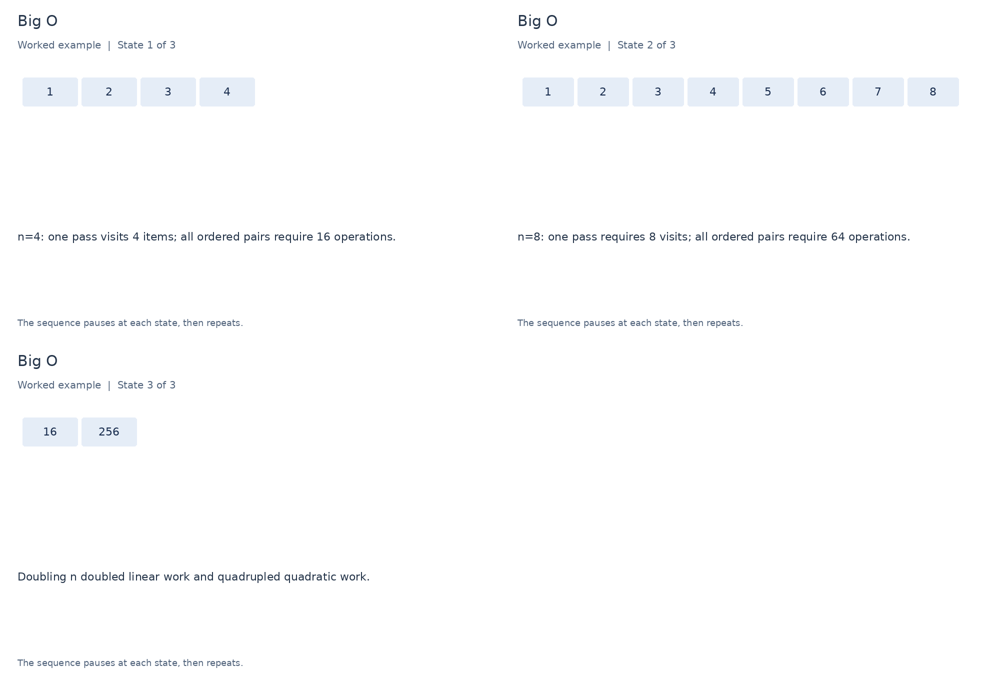
Section titled “Visual walkthrough”Task: For each input size n, count the visits made by one complete pass and the pair operations made by two nested complete passes. Explain how doubling n changes each count.
Sample input: n = 4, 8, 16
Expected output: One pass: 4, 8, 16 visits. All ordered pairs: 16, 64, 256 pair operations.
Constraints and conventions: n is a positive integer. Count the selected loop-body operation; assume it takes constant time.
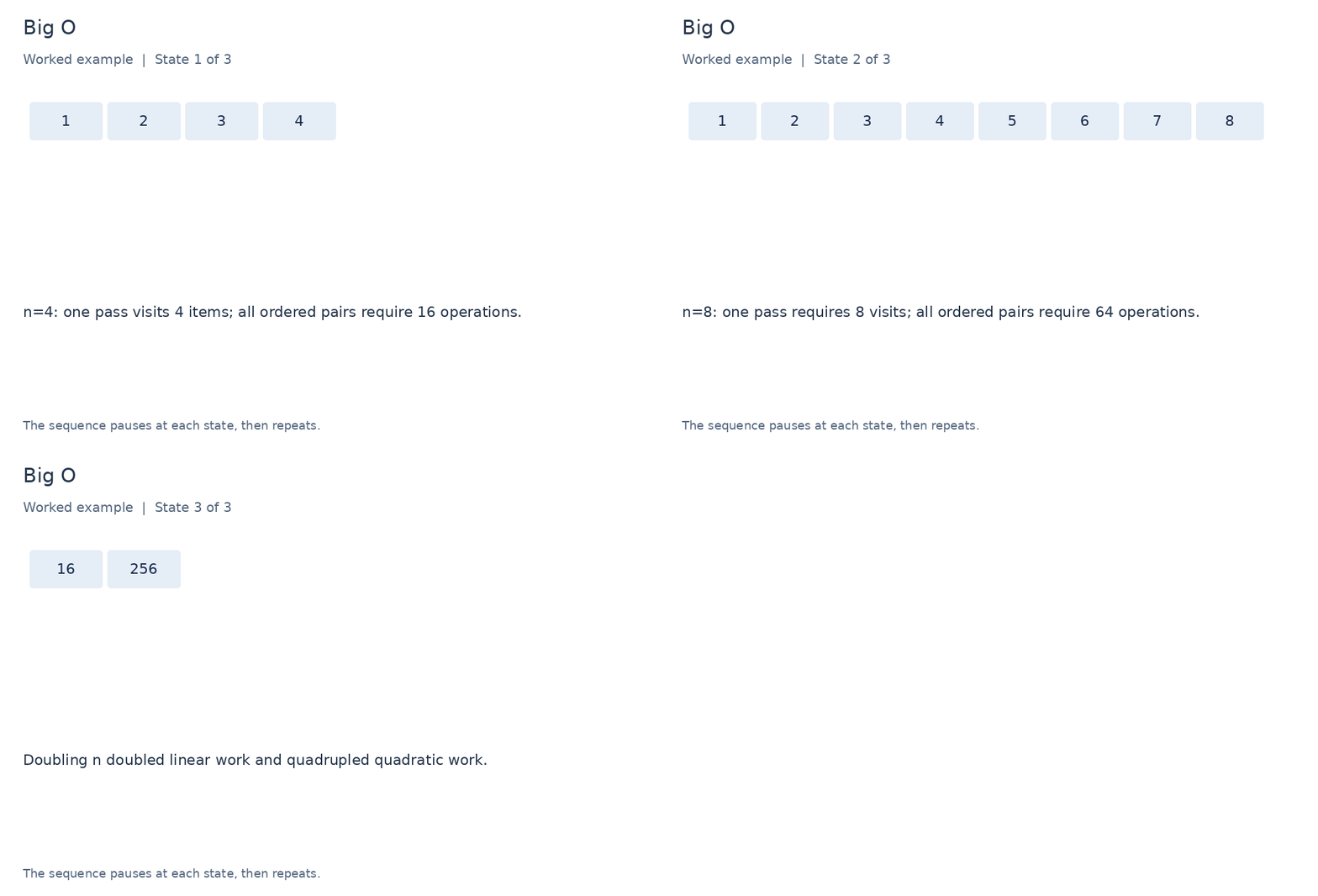
- State:
1 2 3 4. n=4: one pass visits 4 items; all ordered pairs require 16 operations. - State:
1 2 3 4 5 6 7 8. n=8: one pass requires 8 visits; all ordered pairs require 64 operations. - State:
16 256. Doubling n doubled linear work and quadrupled quadratic work.
Open the static revision frames
Python example
Section titled “Python example”def count_pairs(a): return sum(1 for x in a for y in a)assert count_pairs([1, 2, 3]) == 9Complexity and pitfalls
Section titled “Complexity and pitfalls”O(n²) time, O(1) auxiliary space, counting the nested generator iterations.
Two consecutive loops add their costs; nested independent loops multiply them. A loop that halves its range is logarithmic.
Practice
Section titled “Practice”- Count work in two consecutive loops
- Count triangular nested-loop iterations
- Analyze a loop that repeatedly halves n